Adaptive & Smooth Indicators
Adaptive versions of the RSI, CCI, MACD, EMA and more — each with a choice of 8 adaptors and 5 smoothers.
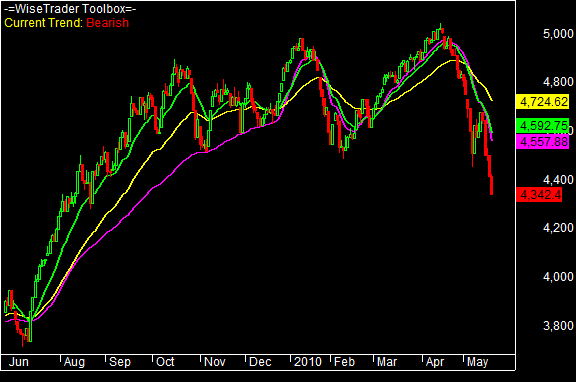
A standard 20-day moving average averages the last 20 bars on every single bar, no matter what the market is doing. But the right look-back is not fixed. When a stock is trending you might want a longer average to stay with the move; when it turns fast and volatile you want a shorter one to get in and out quickly. A fixed period that suits one of those conditions will whipsaw you in the other. Adaptive indicators solve this by changing their effective period bar by bar to match current conditions.
How the Toolbox does it
Each adaptive indicator takes a periods array — one look-back value per bar — in place of a single fixed number, and an adaptor produces that array. The adaptor is the piece that decides the look-back, usually from a measure of trend strength, volatility or cycle length. The Toolbox gives you eight of them:
- Trend Filter (VHF) and R Squared — gauge how strongly the market is trending and lengthen the period in trends, shorten it in chop.
- Statistical — judges whether the market is getting more or less volatile from its fit to a regression line.
- Dominant Cycle, Homodyne Discriminator and Hilbert Transform — measure the market's actual cycle and set the period to it directly.
- SNR and Enhanced SNR — nudge the period up or down by how much noise is present.
With Periods Minimum and Periods Maximum bounds you keep the adapted period inside a sensible range. (AmiBroker's own built-in indicators cannot accept a variable look-back, which is why these adaptive versions only exist in the Toolbox.)
Smoother, with little extra lag
Most of these indicators also offer a choice of five smoothers. A smoother pre-filters the input so that minor, meaningless wiggles never trigger a trade. The key is to smooth the input and never the output: smoothing the input adds very little lag, while smoothing the output adds lag and strips away information. A 4-period WMA smoother on the input is a good starting point for oscillators like the RSI and CCI.
What is covered
Adaptive and smooth versions are included for the RSI, CCI, MACD, EMA, Wilder's MA, Bollinger Bands, Stochastic, StochRSI, TRIX, MFI, DMI, ATR, CMO, the Choppiness Index and the Schaff Trend Cycle.