Instant Trendline
Removes the dominant cycle from price to leave a smooth trendline you can use instead of a moving average.
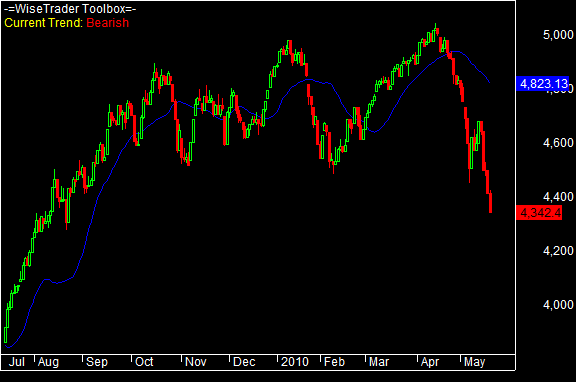
The Instantaneous Trendline is John Ehlers' low-lag trend line, from Rocket Science for Traders. The idea is simple but powerful: if you average price over exactly one full dominant cycle, the up-and-down swings of that cycle cancel out and what remains is the underlying trend. Because the averaging window is matched to the measured cycle rather than to a fixed length, the line reacts quickly while still removing the cyclic noise — which is why it carries less lag than an ordinary moving average of comparable smoothness.
How the Toolbox does it
The indicator measures the dominant cycle on the bar's midpoint, (High + Low) / 2, and averages over exactly that length, recomputing it every bar as the cycle drifts. The Toolbox ships it as a ready-made chart that plots the line over price and marks a buy where price crosses above it and a sell where it crosses below; it also runs as an Exploration.
Swap the DSP engine
Because the averaging window is set by the measured dominant cycle, the estimator that measures that cycle shapes the whole line. Ehlers' original public version used a single method, the Homodyne Discriminator; the Toolbox lets you choose the engine instead, so the same trendline can run smoother, sharper or with less lag depending on which one you pick.
The available engines are:
- Homodyne Discriminator — the low-lag Ehlers default, and what the original public versions used.
- Ehlers alpha Dominant Cycle — a lighter phase-accumulation read you tune by hand.
- Autocorrelation periodogram (Mesa) — a full spectral read, steady on real markets; the open basis of Ehlers' MESA approach.
- Burg maximum-entropy spectrum — the sharpest frequency resolution, best at separating closely spaced cycles.
- Kalman cycle tracker — the lowest lag and the quickest to react when the cycle length changes.
- Concentrated-taper periodogram (Multitaper) — the steadiest reading in noisy data.
The point is that the newer spectral and tracking engines are more powerful than the Homodyne Discriminator the public version relied on — a more accurate window length gives a cleaner, better-timed trendline — and you switch between them with a single setting.
How you would use it
Use it as a responsive trend filter or as a drop-in replacement for a moving average: price above the line suggests an up-trend, below it a down-trend, and the slope of the line itself reads as momentum. It pairs naturally with the cycle oscillators — lean on the Instant Trendline when the market is trending and on a cycle oscillator when it is swinging.